

A quantized AI model stores its weights in a more compact representation. That can reduce the space needed to load it and make local use more practical on a personal computer. There are trade-offs in memory, compatibility and sometimes answer quality or speed. A bit count on its own does not tell you which file will work best on your device.
What model quantization means
A model’s weights are numbers used during training and inference. Quantization represents them with lower precision, for example with 8-bit or 4-bit formats instead of wider representations. Hugging Face describes the aim as reducing the memory needed to load and use a model while trying to preserve accuracy. Different methods have different advantages and limitations. Transformers quantization overview.
A rough storage estimate is weights multiplied by bits per weight, divided by eight. Seven billion weights stored at four bits would therefore take about 3.5 billion bytes for the weights alone. The actual file can be larger because formats may include scales and metadata, and some tensors can use higher precision. This estimate does not describe the RAM needed to run the model.
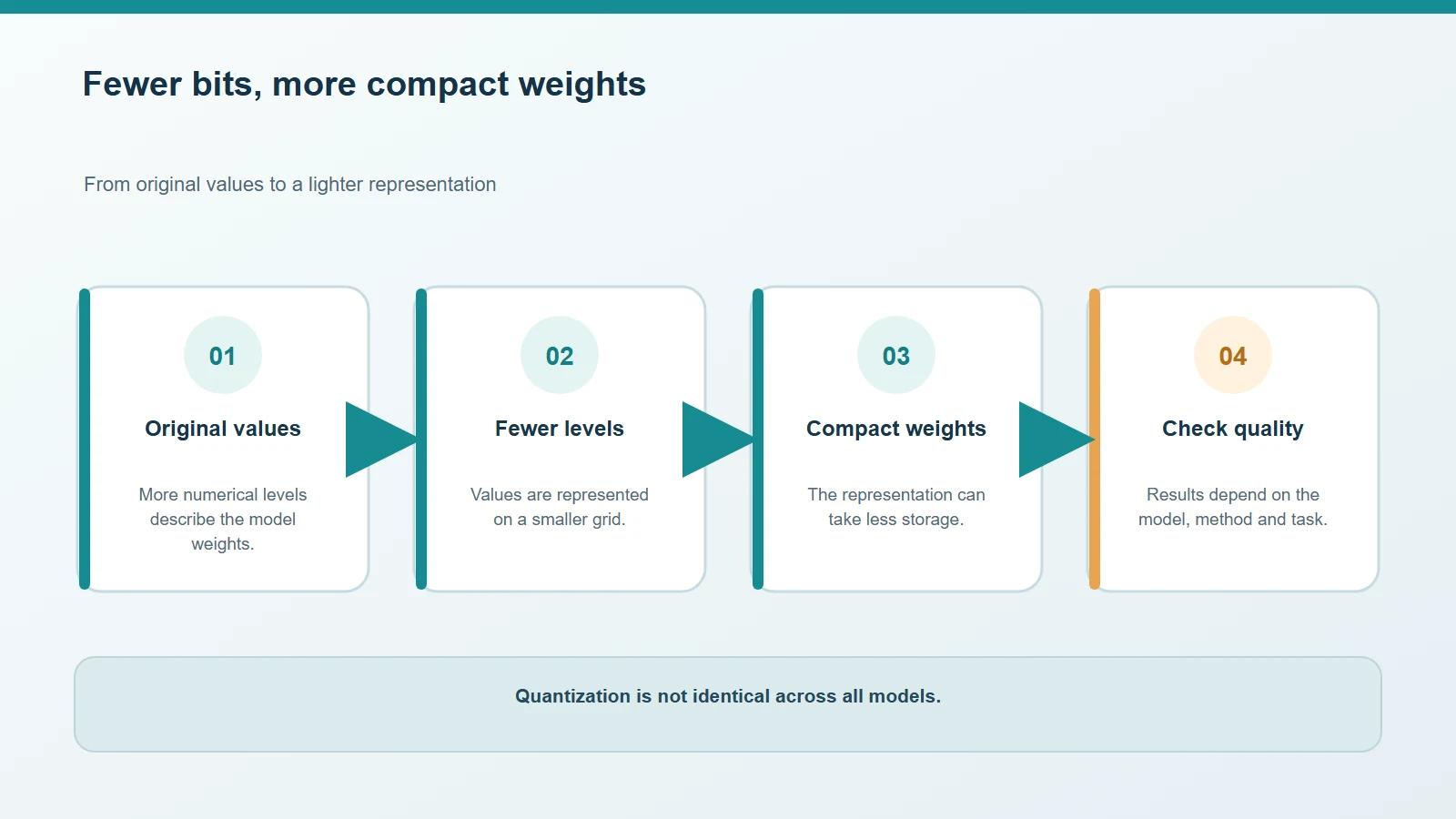
Lower-precision representation can reduce weight storage; results depend on the model and method.
The model file is not the whole memory requirement
While generating an answer, the computer also needs the runtime, working buffers and a KV cache that stores information used as text is processed. Total memory can therefore exceed the download size. Cache use also changes with context length and generation settings: a model that loads may become constrained when you increase conversation length or handle multiple requests.
Hugging Face documents different quantization methods by format, hardware and supported features, and its compatibility guidance accounts for KV-cache memory. Check the estimate for the runtime you plan to use instead of relying only on a “4-bit” label. Supported quantization methods.
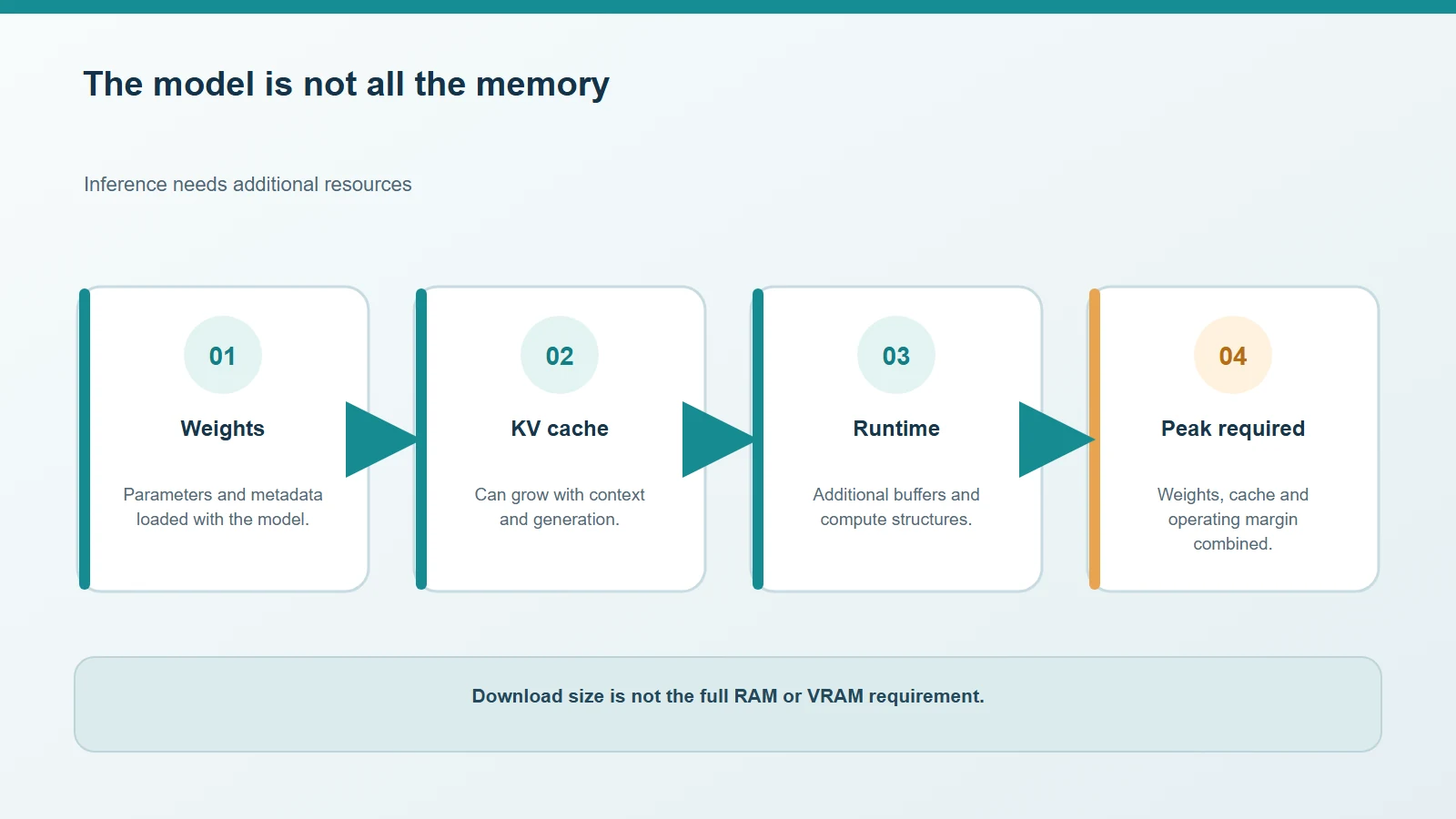
Working memory also includes the cache and runtime.
Not all 4-bit files are alike
A file name may point to a quantization family or configuration, but formats can use different methods, grouping and precision levels. Compatibility also depends on the application: a file supported by one runtime may not open in another, or may require a particular CPU or GPU backend.
Lower bit counts do not guarantee higher speed. A compact representation can reduce memory transfers, but the runtime must process it efficiently and the hardware must support the required operations. Some methods add conversion steps; others are tuned for specific processors. Without testing the same computer, model and task, it would be misleading to promise that a quantized version will always be faster.
How to choose a quantized model
Before downloading, check:
- the format required by your app and compatibility with your processor;
- the file size and total estimated memory, including the cache;
- the context length you need and how many requests you expect to handle at once;
- the model card, licence and distributor’s instructions.
If possible, try prompts similar to the work you will actually do and compare them with a higher-precision version. Look at completeness, accuracy and consistency, not only how quickly the model starts. A benchmark published for another setup does not automatically describe your computer.
Quantization is useful when a model does not fit in available memory or when you want to reduce its storage footprint. If the original version already works well and memory is not a constraint, lowering precision may not provide a practical benefit. For a broader comparison of local and online services, see our guide to local versus cloud AI, and read our NPU and TOPS explainer.


Comments
Comments
Join the discussion respectfully: reasoned criticism is welcome; avoid threats, abuse, personal data and promotional links.
To join the discussion, you'll need to sign in with your WordPress.com account. This feature will be available when the site launches.