

What changes with a solid electrolyte
A solid-state battery replaces the liquid electrolyte with a solid material that lets ions move between the electrodes. That design could enable cells with more energy per unit of mass or volume and avoid some risks associated with liquid electrolytes. It does not automatically make a battery safer, longer-lasting or ready for mass production. Interfaces, stability, manufacturing and safety testing still matter.
What “solid-state” means
In a typical lithium-ion battery, a liquid electrolyte carries ions between the anode and cathode during charging and discharging. A solid-state design uses a solid electrolyte for that transport. The broad electrochemical principle is still to store and release energy through reactions inside a cell; the materials and interfaces are different.
The label does not describe one recipe. Solid electrolytes come in different families, and some designs combine solid components with other materials. An announcement using “solid-state” should therefore be read alongside the cell design and development stage, rather than treated as a promise of uniform performance.
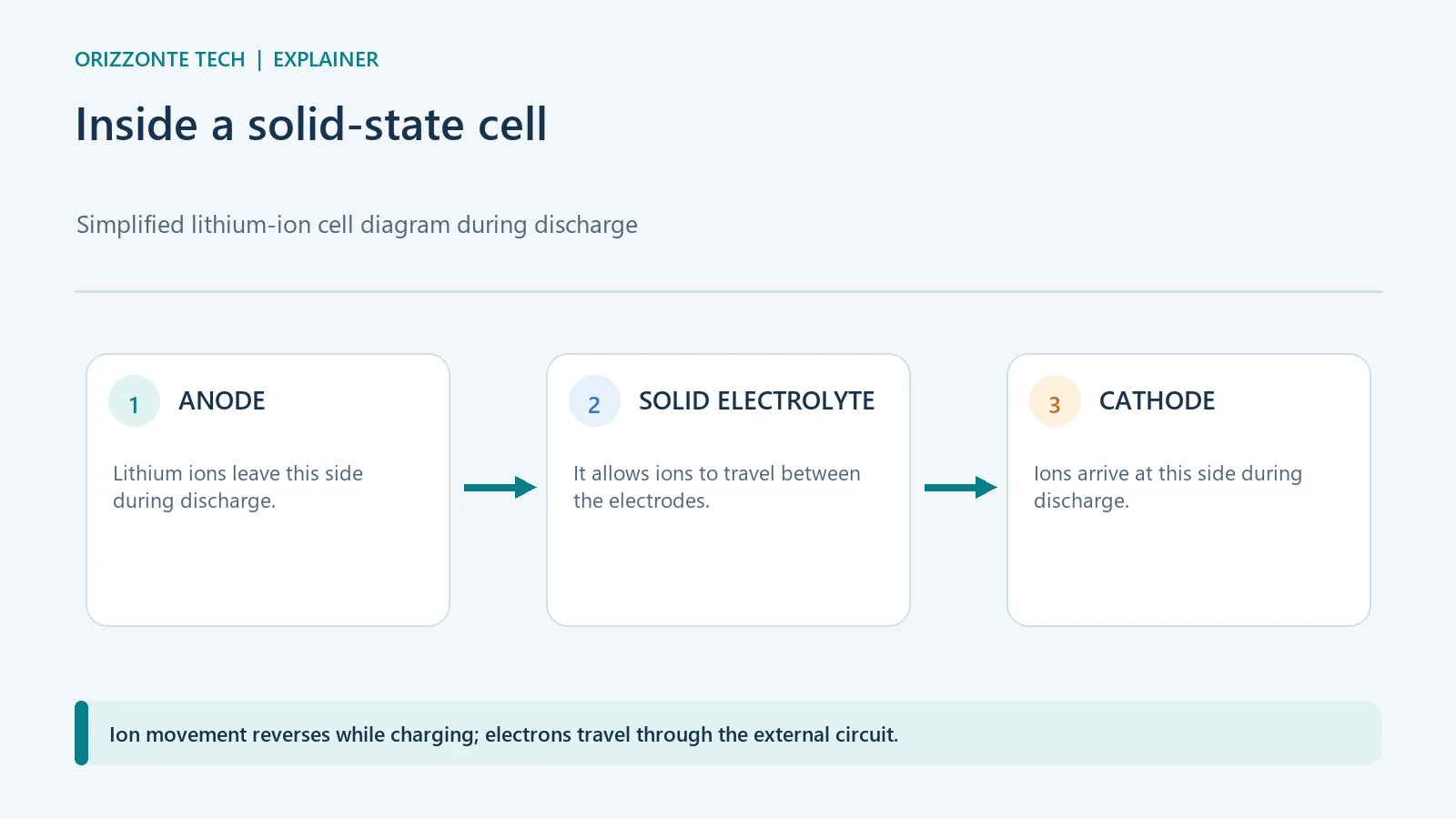
When a lithium cell discharges, ions travel through the electrolyte while electrons move through the external circuit. Charging reverses the direction. X-ray tomography research at the Advanced Photon Source observed that voids could form at lithium–electrolyte interfaces while specific experimental cells operated. The resulting loss of contact contributed to cell failure in the cells studied. This is evidence about an engineering challenge, not a prediction for every commercial battery.
Potential benefits
A solid electrolyte may allow cell designs with more energy per unit of mass or volume. Some materials are non-flammable under the conditions considered in particular research projects, which can be a design advantage. These are possibilities, not guaranteed properties of every chemistry or product.
Energy density also depends on the complete cell: electrodes, electrolyte, current collectors, enclosure, thermal management and safety margins. A promising cell still has to become a module and pack suitable for actual use. The mass, volume and safety of the whole system cannot be inferred from the electrolyte alone.
Why safety is not automatic
Replacing a flammable liquid electrolyte does not eliminate every possibility of overheating or failure. The U.S. Department of Energy notes that, under some short-circuit conditions, higher energy density can concentrate more heat in a smaller volume. Safety assessment must therefore consider the complete design, possible defects and the required tests.
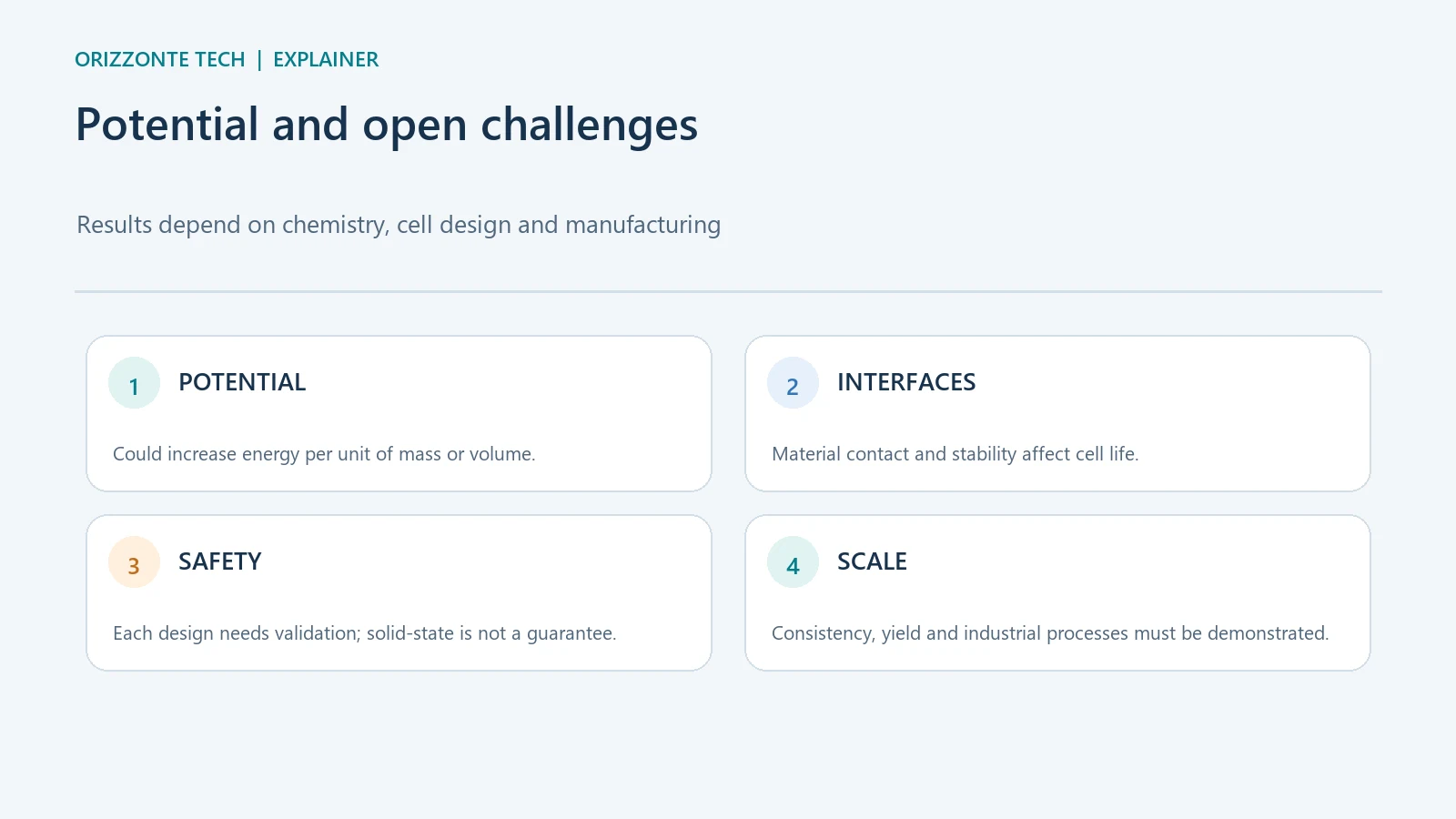
Producing large cells consistently is another challenge. The Department of Energy continues to support work to scale electrolyte materials and manufacturing processes to larger formats and higher production volumes. Those programs document an industrialisation challenge; they do not prove that no solid-state product is already available, or that any particular commercial announcement is false.
How to read product claims
Before comparing a battery, ask: which chemistry was used? Does the figure describe a lab cell, module or vehicle? Was it independently verified? Are cycle life, temperature, charging, safety and test conditions reported? What schedule has the manufacturer announced, and which production stage has actually been reached?
Commercialisation dates announced by companies are attributed targets, not completed results. Without comparable data, it is more accurate to describe potential and open challenges than to promise faster charging, longer range or a “risk-free” battery.
Sources and limits
- Argonne National Laboratory: interface observations in solid-state cells — research on specific experimental cells, published in 2021.
- U.S. Department of Energy: Energy Storage Safety Strategic Plan — includes safety validation considerations for emerging technologies.
- U.S. Department of Energy: 2025 projects to commercialise energy technologies — includes a project on manufacturing solid electrolytes.
Sources checked on 29 October 2026. No battery was tested for this article; the inline images are editorial diagrams, not photographs of tests or products.



Comments
Comments
Join the discussion respectfully: reasoned criticism is welcome; avoid threats, abuse, personal data and promotional links.
To join the discussion, you'll need to sign in with your WordPress.com account. This feature will be available when the site launches.