
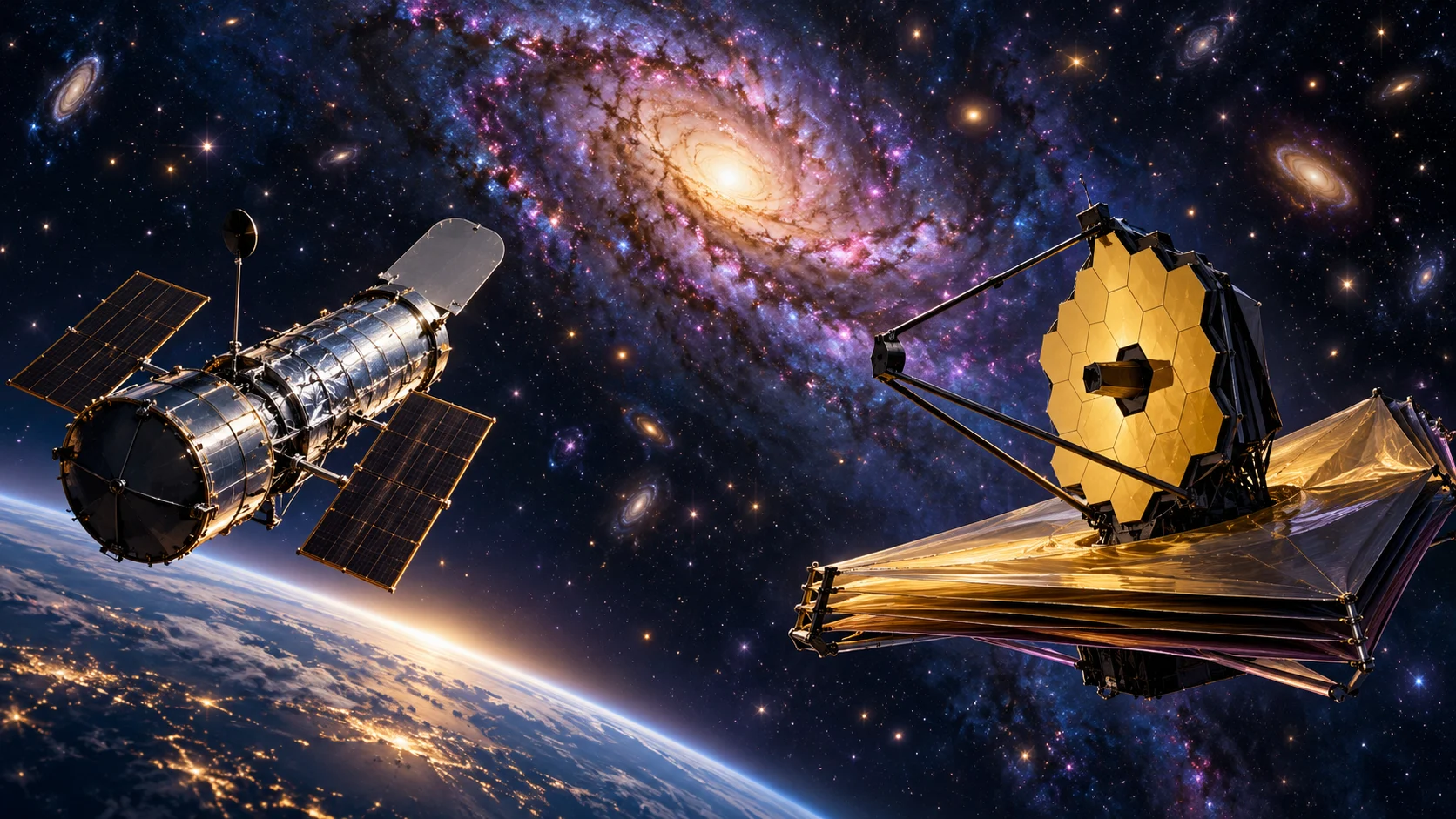
James Webb did not replace Hubble. The two space telescopes observe different parts of the light spectrum and operate in different locations, giving astronomers information that one observatory alone could not provide. Webb is especially sensitive to infrared light; Hubble remains valuable for ultraviolet and visible observations.
Two telescopes, different views
The key difference is the light their instruments collect. Hubble can observe some infrared wavelengths, but it was designed primarily for ultraviolet and visible light. Webb reaches much farther into the infrared, including mid-infrared wavelengths, with instruments built to take images and spectra in those bands (NASA — Hubble vs Webb, NASA — Webb’s instruments).
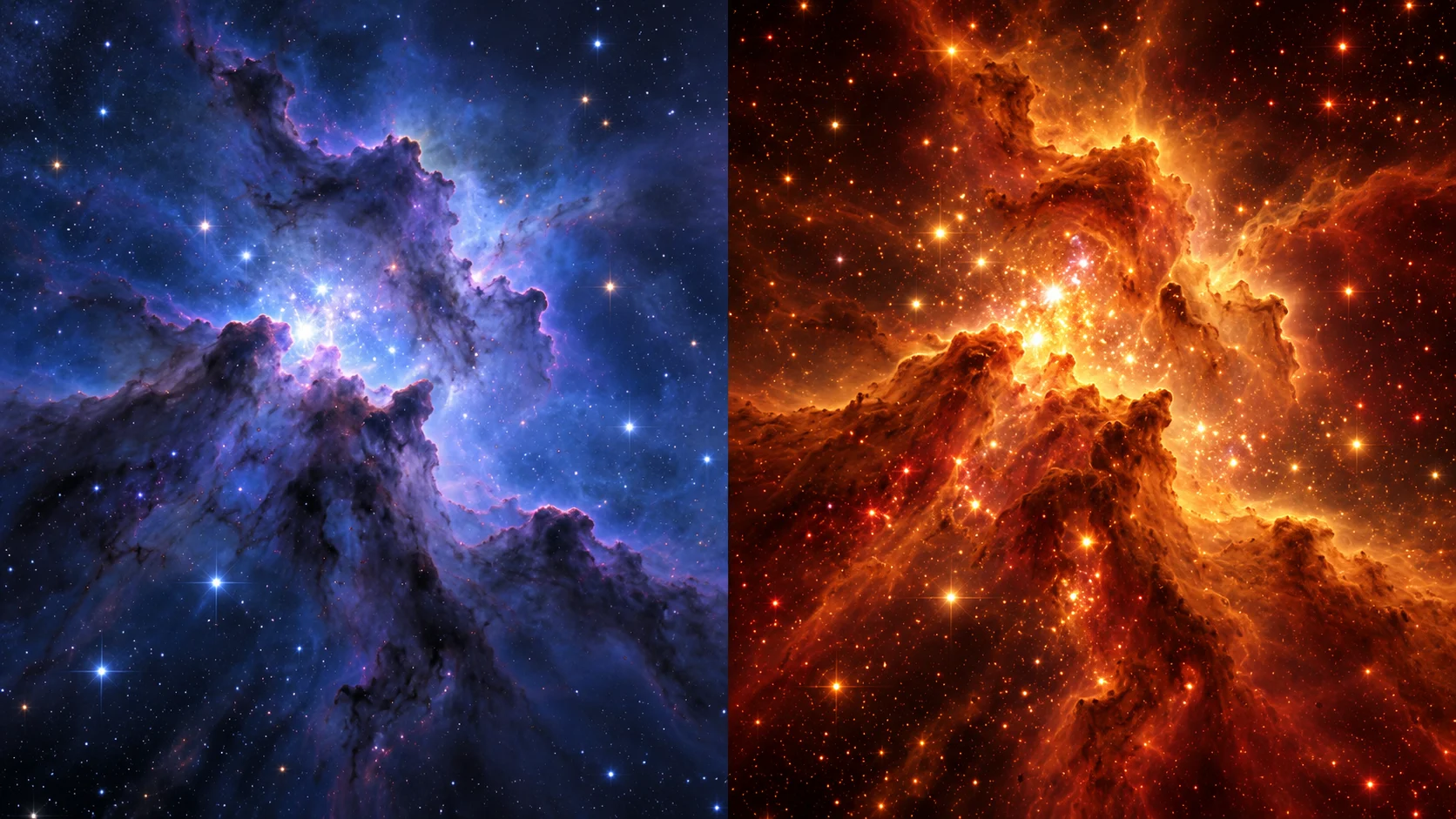
Infrared is not simply a “better” version of visible light. Some infrared wavelengths pass more easily through clouds of dust and gas, and the expansion of the universe stretches light from distant objects toward longer wavelengths. Webb can therefore investigate details that are harder for Hubble to see, while Hubble remains especially useful at shorter wavelengths.
Their mirrors differ too. Hubble’s primary mirror is 2.4 metres across; Webb’s is 6.5 metres. NASA says Webb has more than six times Hubble’s light-collecting area. That does not mean Webb always produces sharper images: resolution also depends on wavelength and instruments. NASA notes that Webb’s near-infrared resolution is similar to Hubble’s in visible light (NASA — mirror comparison, Hubble facts).
Their orbits reflect their jobs
Hubble orbits Earth about 483 kilometres above the surface. Webb follows an orbit around the Sun near the second Lagrange point, L2, about 1.5 million kilometres from Earth. From there, the Sun, Earth and Moon stay in roughly the same direction behind Webb’s large sunshield, which helps keep the observatory cold. The distance makes Webb difficult to service with repair missions, while Hubble was designed to be serviced in space (NASA — Hubble orbit, NASA — Webb orbit).
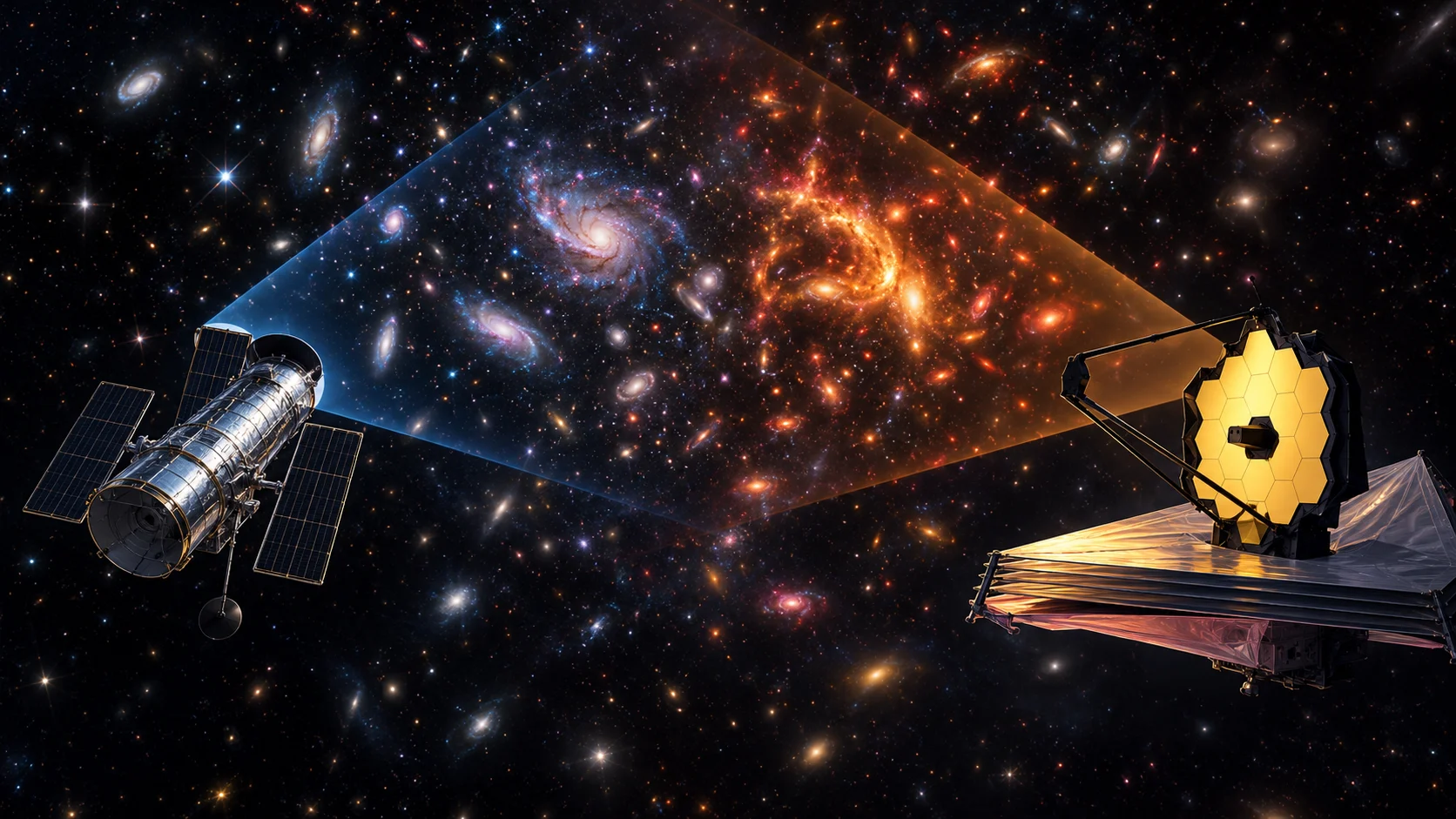
The illustrations here are conceptual. They are not photographs or observations from Hubble or Webb.
Different discoveries, not a contest
Hubble has contributed to many fields, from galaxy evolution to measurements of the expanding universe. Observations of distant supernovae in the 1990s were among the key evidence that led astronomers to discover the universe’s accelerating expansion (NASA — Hubble and dark energy).
Webb was designed to collect faint infrared light from distant objects. One dated example comes from the JADES programme: in December 2022, NASA reported spectroscopic confirmation of four galaxies at redshift greater than 10. That result belongs to that observing campaign; it is not a claim about today’s most distant known object (NASA — JADES results).
Research teams often use more than one instrument. Webb can find and study infrared sources while Hubble adds observations in ultraviolet or visible light. Combined telescope images are not always “natural-colour photographs”: instruments record wavelengths our eyes cannot see, and researchers assign colours to make the data readable.
Why keep both observatories working?
Astronomical questions rarely fit into one wavelength band. Observing the same object with different instruments can help scientists understand its temperature, composition, distance and history. Webb extends infrared sensitivity; Hubble adds complementary capabilities and a long record of observations. Which telescope is most useful depends on the research question.
Visit the Science section for future science features. There is no existing related article to link here without forcing an irrelevant recommendation.

Comments
Comments
Join the discussion respectfully: reasoned criticism is welcome; avoid threats, abuse, personal data and promotional links.
To join the discussion, you'll need to sign in with your WordPress.com account. This feature will be available when the site launches.