

When you travel occasionally in a country covered by “Roam Like at Home”, you can use your mobile plan at domestic rates for calls, texts and data. Since 1 January 2026, the area also includes Ukraine and Moldova. That does not mean every SIM works everywhere without limits: check your plan, data allowance and the type of network you may connect to before you leave. The European Commission’s roaming questions and answers.
Where the rules apply
The scheme covers all 27 EU countries and the European Economic Area: Iceland, Liechtenstein and Norway. Ukraine and Moldova have been included since 2026. The United Kingdom is not automatically covered, although some operators include it in their plans. Switzerland and other destinations outside the area may also be included commercially, but check your provider’s list rather than assuming they are.
The rules apply to plans that include roaming and are intended for occasional travel, not for using a SIM permanently in another country. Calls, texts and data count against your domestic plan under the applicable conditions. The Commission’s overview of Roam Like at Home.
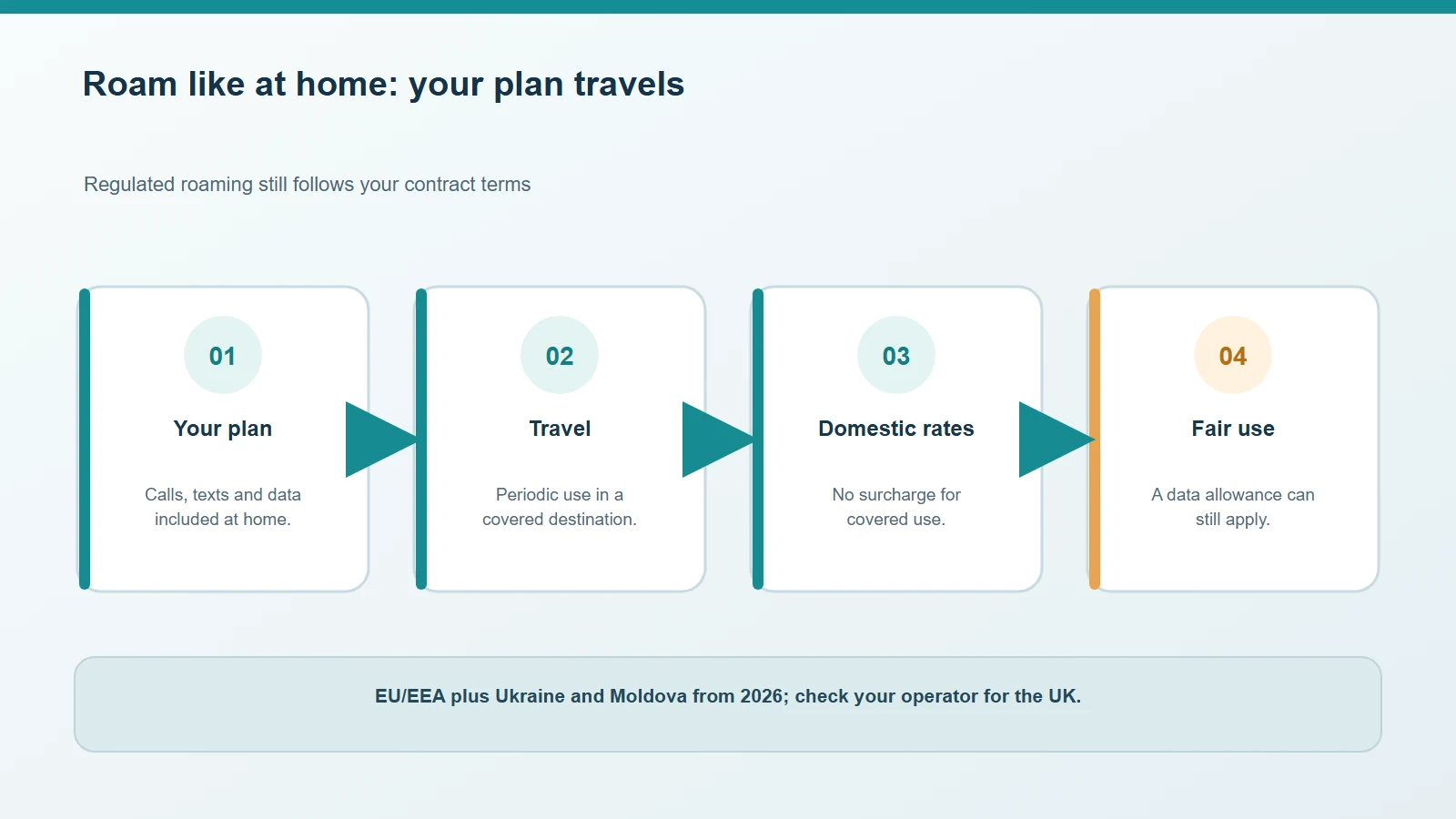
Regulated roaming follows your domestic plan in covered destinations, subject to fair-use conditions.
Data may have a fair-use allowance
If your home plan includes unlimited data or very cheap data, your operator may apply a fair-use limit while you are abroad. It must tell you what the limit is and alert you as you approach it; the allowance depends on your plan and the applicable rules. Use beyond that threshold may carry a regulated surcharge. So do not rely on “unlimited” in an advert alone: check how many gigabytes are available for roaming and how they are counted.
Roam Like at Home is meant for periodic trips, not for using a SIM permanently in another country. The Commission says the relevant pattern is spending and using your phone more at home than abroad. If you expect a long stay, check your provider’s terms before you leave.
Ships and aircraft can use satellite networks
The rules cover terrestrial mobile networks. At sea or during a flight, your phone may connect to a non-terrestrial satellite network, which is not covered by the same price caps. Charges can be high even when the ship or aircraft is travelling through an EU country.
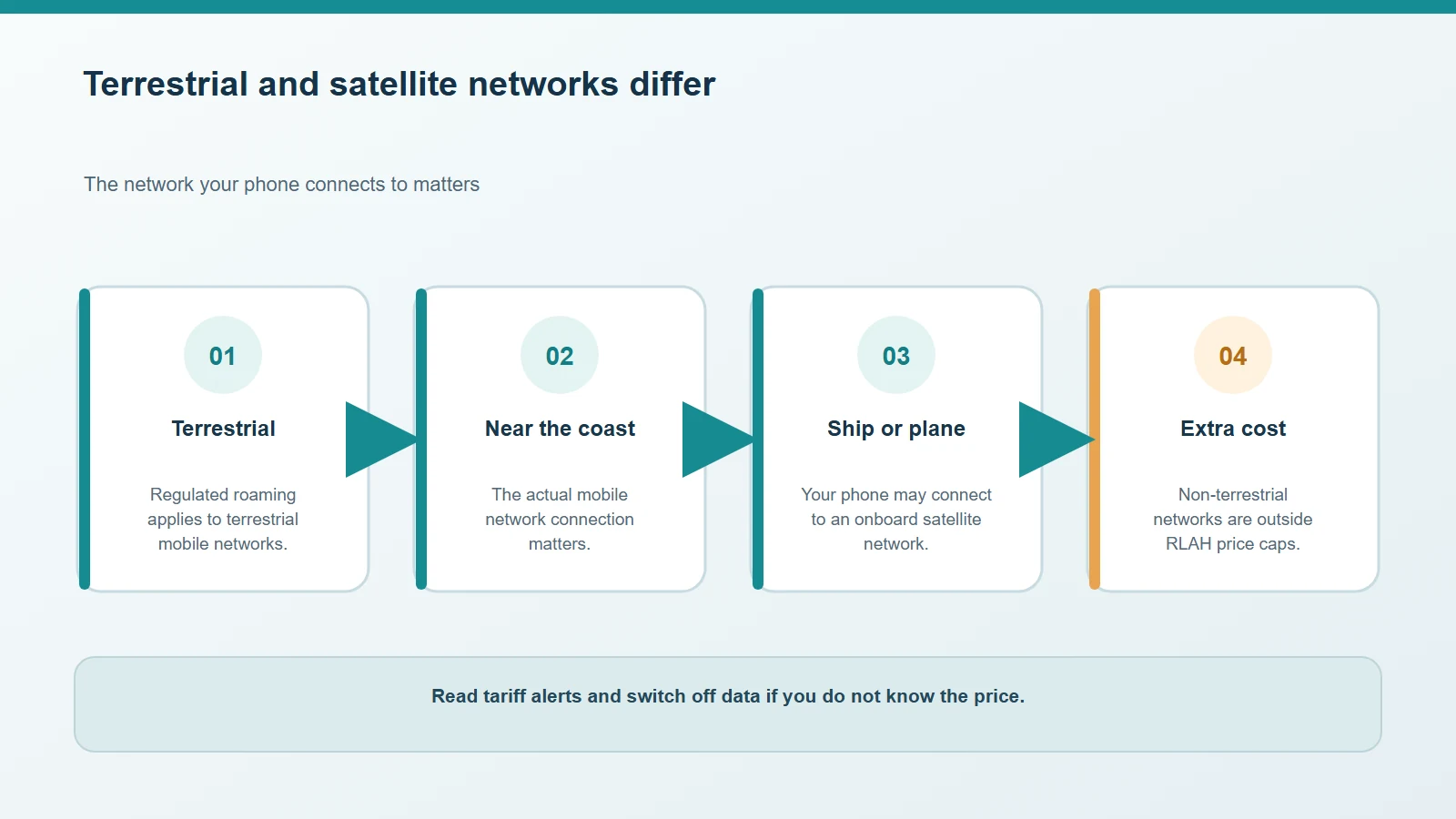
EU roaming rules apply to terrestrial networks, not onboard satellite networks.
If you do not need connectivity in flight or at sea, turn on airplane mode and switch Wi-Fi back on only if you want to use the ship’s or aircraft’s network, after checking its price. You can also disable data roaming in your phone settings; menu names vary by device and provider. Calls to special-rate numbers can have different charges as well.
Five checks before leaving
- Search for your destination in your operator’s list, including transit countries.
- Check your roaming data allowance and plan conditions.
- Read the information message sent when you arrive.
- On a ship or aircraft, check the network name before leaving mobile data on.
- If you use a travel eSIM, read its plan terms: it does not automatically inherit EU roaming from your regular SIM.
For travel data options, see our eSIM guide and our offline maps guide.



Comments
Comments
Join the discussion respectfully: reasoned criticism is welcome; avoid threats, abuse, personal data and promotional links.
To join the discussion, you'll need to sign in with your WordPress.com account. This feature will be available when the site launches.